Hi, it's Kasia Frendl of Motocaina.pl and I'm greeting you onboard the Audi Q3.
It's a second-generation model that undergone visual upgrade and I had a chance to test it
on the road, going from Warsaw to Krakow.
I was given a 2.0 diesel model,
with a slightly confusing name of 35 Advanced TDI.
The name could suggest a 3.5-liter engine,
but in fact it's a 2.0-liter 150 horsepower engine,
generating 340 Nm of torque.
This engine is paired – at least during the initial offering
– with a 6-speed manual gearbox.
The 7-gear S-Tronic transmission will become available soon.
Automatic transmission will, however, make the car front-wheel-drive,
while the option here is paired with a Quattro.
The four-wheel-drive is achieved in this car through a hydraulic clutch.
The car is quite heavy and that's noticable on the road,
so I'm happy to have a manual gearbox.
The gears are of the right lenght and even the gearbox handle has a short throw,
making the shifts very comfortable.
On paper, this engine is capable of accelerating the car to 100 km/h in 9.3 seconds,
but it seems a tad slower in the real world.
However, it's not a race car but a SUV, so I don't expect anyone to buy it for its sporting abilities.
SUV also means a tall chassis, that's also noticable, along the weight.
The aforementioned 150 HP engine is the base for this model.
Going the petrol route, you can go as high as 230 HP.
That engine could then be paired with a sporty chassis and adaptive suspension, if someone wants such trim.
I needed to stop in order to tell you more about this car.
First of all, the manufacturer declares the car should burn about 6.9 liters per 100 km in combined cycle.
I was driving within the limits, using the Dynamic mode though, and my result was 8.8 l/100 km.
It's a little more than declared, but let's say it's within reason.
Remember, this is the smallest diesel engine available for this car.
What has been changed from the car's predecessor, and what's almost instantly noticable,
is that the vehicle has been lenghtened by almost 10 cm.
Such move is a rarity, since these days cars are widened much more often than lenghtened.
Increasing the dimensions allowed for the interior to be more spacious and that can be felt.
The wheel base has also been extended by over 7 cm,
meaning the car is now more stable on the road.
This, combined with the upgraded suspension,
increased the traction and the car feels better to the driver.
The car is still – let's say compact for an SUV
– but is very comfortable to drive.
During my trip to Krakow I encountered all kinds of conditions – from snow to rain and almost hail.
The Quattro really made a difference. It helped me keep the car within the lines and made the trip comfortable.
Going back to the interior, the rear row of seats is adjustable within 15 cm range,
providing big flexibility, whether you want more leg room or need to put more stuff in the trunk.
For those who want to cover longer distances, there's good news:
the seats can be tilted back, creating a very comfortable space for a quick power nap.
The trunk's capacity is 530 liters, which is a rather mediocre number in this segment,
but with back seats folded it increases to 1525 liters, which is quite a lot.
This particular car is sporting a S-Line design variant – one of three available
– which includes those very comfortable upholstered sporty seats.
The seats here are buckety and hold the body very well during cornering.
There's also this beautiful S-Line emblem embroided onto them.
The surface feels like suede, but it's artificial leather.
Which is good, because no animals were harmed in the name of our comfort.
The inside of the seats has been filled with the premium Alcantara fabric.
I really like this combination, because real leather can get really cold in winter,
which doesn't make for a nice experience if the seats aren't heated.
Furthermore, the front seats include adjustable lumbar section, that can be set into one of four positions.
In front of me I have another paid add-on – the three-spoke steering wheel, that's flattened at the bottom.
The steering wheel is very comfortable to hold.
On the sides there's a perforated skin, which is just one example of the quality and attention to details,
that's synonymous with the Audi name.
Behind the steering wheel there's the Virtual Cockpit.
The 12.3" screen can, for example, be used to its full extend to display the navigation – very useful.
There's plenty of personalisation options, but I really prefer this layout
with a full-width map and smaller RPM- and speedometers.
It provides me with all the data I could need on the road.
What's new is the secondary screen on the center console, with the optional touch functionality.
It's beautifully integrated into the black glass and looks really elegant.
Obviously all touchscreens are fingerprint magnets,
but those can be easily wiped away, so I don't consider it as a big drawback.
The interface is clear and intuitive, so performing all the functions is really fast.
There are voice commands and buying the Audi Connect functionality
will give you a LTE modem with on-board hotspot and additional functionalities like online navigation.
That last one is really cool, as the sat nav will direct you around the traffic, accidents and road works,
like the one I had to encounter during my trip.
Everything works without a hitch and I consider Audi's infotainment system as currently one of the best.
What else, there's plenty of compartments and both front and back seats have armrests and cup holders.
Inside the center console there's a bay than can easily fit all your electronics, alongside two USB charging ports.
The onboard computer has plenty of driving programmes built-in: there's Dynamic I mentioned earlier,
Comfort, Automatic mode and Individual where every parameter
– like the steering system, throttle responsiveness or suspension – can be set independently,
depending on our style or the conditions and terrain.
What's probably the coolest aspect of this car is its configurability.
Almost everything can be personalised, so the one you pick up from the dealership will be exactly to your liking.
Obviously the additional options are not cheap.
The car I'm currently seating in has a base price of little over 163 000 PLN.
Unfortunately, the additional equipment has bumped the price to almost 230 000 PLN,
but then the car has everything I would wish for, including my personal favourite – ambient lighting.
It would be hard to see its effect in daylight, but you can set it into one of 30 different shades.
The new Q3 might not look like a radical change from the outside,
even though the manufacturer says it's now supposed to look more sporty.
There are changes though, including the wider and more angular single-frame radiator inlet.
On the sides of the car some nice creases can be found
and the roof line seems to end lower than in the previous model.
But in general, if you would put both generations side-by-side, you would be hard pressed to tell them apart.
The LED lights are in standard trim, and there are optional Matrix LEDs, alongide adaptive lamps,
and the rims can be selected from 17" up to 20" ones.
 For more infomation >> Come sostituire molle di sospensione posteriori su AUDI A3 1 (8L1) [TUTORIAL AUTODOC] - Duration: 2:33.
  For more infomation >> Hvordan bytte bak støtdemper der på AUDI A3 1 (8L1) [BRUKSANVISNING AUTODOC] - Duration: 4:40.
 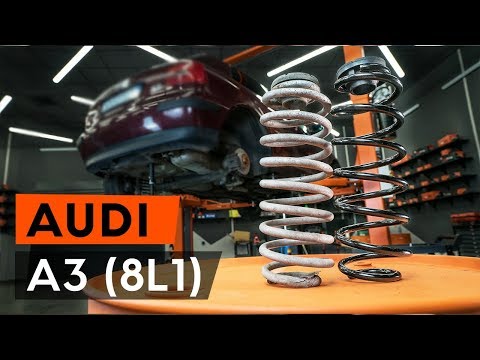 For more infomation >> Kaip pakeisti galiniai pakabos spyruoklė AUDI A3 1 (8L1) [PAMOKA AUTODOC] - Duration: 2:33.
  For more infomation >> Hvordan bytte bak bremseskiver der på AUDI A3 1 (8L1) [BRUKSANVISNING AUTODOC] - Duration: 4:12.
  For more infomation >> Cum se înlocuiește arc de suspensie din spate AUDI A3 1 (8L1) [TUTORIAL AUTODOC] - Duration: 2:33.
 For more infomation >> Jak wymienić tylne tarcze hamulcowe w AUDI A3 1 (8L1) [TUTORIAL AUTODOC] - Duration: 4:12.
  For more infomation >> Cum se înlocuiește filtru de aer motor pe AUDI A3 1 (8L1) [TUTORIAL AUTODOC] - Duration: 2:40.
  For more infomation >> Kaip pakeisti variklio oro filtras AUDI A3 1 (8L1) [PAMOKA AUTODOC] - Duration: 2:40.

Không có nhận xét nào:
Đăng nhận xét